Définition de l’état de flow
Le flow est un état de pleine concentration, de symbiose avec le travail actuel, de pleine Attention à l’acte.
Comme par exemple en danse quand on rentre dans un état spécifique et que la danse prend le dessus, que les mouvement nous viennent et qu’on ne perçoit plus le temps.
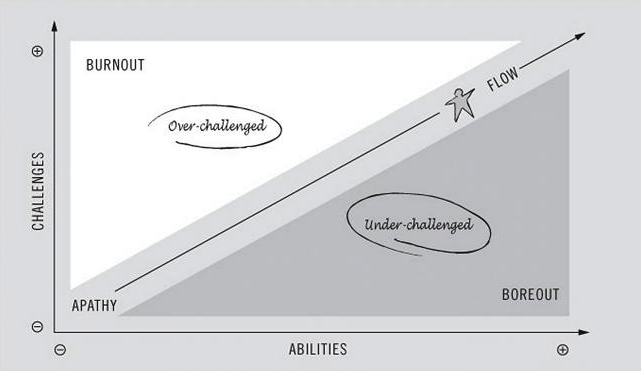
Le juste effort doit être assez intense pour obtenir la performance désirée mais assez relâché pour ne pas se blesser ni s’épuiser.
Chercher à contrôler son effort pour le rendre juste est une méditation qui procure une grande joie
Le protocole pour entrer en flow
Pour être dans le flow, il faut coller à l’effort. Il faut comprendre que si on accueille, aime et accepte un effort particulier et les sensations qui y sont associées dans le corps, alors il devient très facile de s’améliorer constamment et de se perfectionner dans une discipline. Exemple : la marche avec les raquettes
Si je comprends que je dois coller à l’effort, alors j’apprends à rechercher cette sensation d’effort dans mes jambes. Alors ça devient facile d’aimer et de s’accommoder de cette sensation, et donc je ne souffre pas de l’effort. Je suis dans le flow — Antonin Adert
Flow activities have built-in goals, feedback, rules, and challenges, all of which encourage one to become involved in one’s activity, to concentrate and lose oneself in it.
Even the simplest physical act becomes enjoyable when it is transformed so as to produce flow. The essential steps in this process are:
- to set an overall goal, and as many subgoals as are realistically feasible
- to find ways of measuring progress in terms of the goals chosen;
- to keep concentrating on what one is doing, and to keep making finer and finer distinctions in the challenges involved in the activity
- to develop the skills necessary to interact with the opportunities available
- to keep raising the stakes if the activity becomes boring.
—Mihaly Csikszentmihalyi
Les obstacles indivuduels et collectif pour rentrer dans le flow
A less drastic obstacle to experiencing flow is excessive self-consciousness. A person who is constantly worried about how others will perceive her (Te débarrasser du jugement des autres), who is afraid of creating the wrong impression, or of doing something inappropriate, is also condemned to permanent exclusion from enjoyment. So are people who are excessively self-centered. A self-centered individual is usually not self-conscious, but instead evaluates every bit of information only in terms of how it relates to her desires.
Attentional disorders and stimulus overinclusion prevent flow because psychic energy is too fluid and erratic. Excessive self-consciousness and self-centeredness prevent it for the opposite reason: attention is too rigid and tight. Neither extreme allows a person to control attention.
Two terms describing states of social pathology apply also to conditions that make flow difficult to experience: anomie and alienation. Anomie—literally, “lack of rules”
Alienation is in many ways the opposite: it is a condition in which people are constrained by the social system to act in ways that go against their goals.
It is interesting to note that these two societal obstacles to flow, anomie and alienation, are functionally equivalent to the two personal pathologies, attentional disorders and self-centeredness. At both levels, the individual and the collective, what prevents flow from occurring is either the fragmentation of attentional processes (as in anomie and attentional disorders), or their excessive rigidity (as in alienation and self-centeredness). At the individual level anomie corresponds to anxiety, while alienation corresponds to boredom.
—Mihaly Csikszentmihalyi
Description du flow par un danseur
As a result, one of the most universal and distinctive features of optimal experience takes place: people become so involved in what they are doing that the activity becomes spontaneous, almost automatic; they stop being aware of themselves as separate from the actions they are performing.
A dancer describes how it feels when a performance is going well: “Your concentration is very complete. Your mind isn’t wandering, you are not thinking of something else; you are totally involved in what you are doing…. Your energy is flowing very smoothly. You feel relaxed, comfortable, and energetic.” — Mihaly Csikszentmihalyi
Origine
Concept popularisé par le psychologue hongrois Mihaly Csikszentmihalyi, le flow se caractérise par la capacité à soutenir une attention dirigée, la curiosité, la persistance et la faible centration sur soi.
On dit d’un individu dans le flow que c’est une Personnalité autotélique ; elle agit en fonctions de ses propres buts et non pas en vue d’un bénéfice qui viendrait de l’extérieur
Voici les mots de Mihaly Csikszentmihalyi sur le flow :
une expérience particulière est vécue, par laquelle une personne ressent à la fois le dépassement de soi et une sensation de maîtrise et de joie ( Czsikszentmihalyi 1990, 2006 ; Snyder et Lopez, 2007)
10 lois du flow
Jean Cottraux rappelle que ce flux se situe entre l’angoisse liée au sentiment d’incapacité de réaliser une tâche et l’ennui qui résulte de la paresse.
Il a été établi 10 lois du flow :
- La tâche est difficile, mais demeure réalisable et représente un défi par rapport à la vie banale.
- Elle sort du quotidien et guérit de l’ennui
- La concentration sur la tâche est au maximum
- Le but recherché est clair et bien défini
- L’action possède des conséquences perceptibles immédiatement
- L’engagement de la personne dans la tâche est complet
- La personne ressent un sentiment de maîtrise et de contrôle de ses actions.
- Elle se perçoit temporairement comme invulnérable : c’est le fonctionnement héroïque.
- La préoccupation de soi disparaît pendant l’action dans laquelle le sujet est totalement immergé : le sujet fait corps avec la machine qu’il conduit ou bien avec l’instrument dont il joue
- La perception de la durée est altérée : la distorsion du temps peut aller dans un sens du temps plus court ou plus long. Mais l’activité elle-même requiert une exacte perception du temps, il est nécessaire d’avoir conscience de celui-ci
- Le sens de soi et la conscience positive de soi se trouvent renforcés après l’action. Les conséquences positivent du flux renforcent la répétition de l’action, car le sentiment de maîtrise est gratifiant
- Le plaisir ressenti va conduire la personne qui a connu le flux à chercher le à retrouver les mêmes sensations
L’alignement s’opère quand on touche sa source de créativité.
En redécouvrant le flow, je suppose que le flow est la conséquence de ton alignement.
On peut augmenter ses chances de rentrer dans le flow en divisant les tâches pour bien percevoir l’objectif qui doit être atteignable. Une bonne structure permet le flow.
Plus on rentre dans le flow, plus on devient une personne complexe
Plus on rentre dans le flow, plus on devient une personne complexe. On devient complexe car on combine le fait d’être unique et le fait d’être en communion avec les autres.
Following a flow experience, the organization of the self is more complex than it had been before. It is by becoming increasingly complex that the self might be said to grow.
Complexity is the result of two broad psychological processes: differentiation and integration. Differentiation implies a movement toward uniqueness, toward separating oneself from others. Integration refers to its opposite: a union with other people, with ideas and entities beyond the self. A complex self is one that succeeds in combining these opposite tendencies.
The self becomes more differentiated as a result of flow because overcoming a challenge inevitably leaves a person feeling more capable, more skilled.
After each episode of flow a person becomes more of a unique individual, less predictable, possessed of rarer skills.
Complexity is often thought to have a negative meaning, synonymous with difficulty and confusion. That may be true, but only if we equate it with differentiation alone. Yet complexity also involves a second dimension—the integration of autonomous parts. A complex engine, for instance, not only has many separate components, each performing a different function, but also demonstrates a high sensitivity because each of the components is in touch with all the others. Without integration, a differentiated system would be a confusing mess.
Only when a person invests equal amounts of psychic energy in these two processes and avoids both selfishness and conformity is the self likely to reflect complexity.
it is when we act freely, for the sake of the action itself rather than for ulterior motives, that we learn to become more than what we were.
When we choose a goal and invest ourselves in it to the limits of our concentration, whatever we do will be enjoyable.
—Mihaly Csikszentmihalyi
La conscience de soi disparaît dans le flow
Dans le flow, on perd la partie consciente de soi mais on se connecte plus à soi.
We have seen earlier that when an activity is thoroughly engrossing, there is not enough attention left over to allow a person to consider either the past or the future, or any other temporarily irrelevant stimuli. One item that disappears from awareness deserves special mention, because in normal life we spend so much time thinking about it: our own self.
Hundreds of times every day we are reminded of the vulnerability of our self. And every time this happens psychic energy is lost trying to restore order to consciousness.
But in flow there is no room for self-scrutiny. Because enjoyable activities have clear goals, stable rules, and challenges well matched to skills, there is little opportunity for the self to be threatened.
The absence of the self from consciousness does not mean that a person in flow has given up the control of his psychic energy, or that she is unaware of what happens in her body or in her mind. In fact the opposite is usually true. When people first learn about the flow experience they sometimes assume that lack of self-consciousness has something to do with a passive obliteration of the self, a “going with the flow” Southern California-style. But in fact the optimal experience involves a very active role for the self.
So loss of self-consciousness does not involve a loss of self, and certainly not a loss of consciousness, but rather, only a loss of consciousness of the self. What slips below the threshold of awareness is the concept of self, the information we use to represent to ourselves who we are.
This growth of the self occurs only if the interaction is an enjoyable one, that is, if it offers nontrivial opportunities for action and requires a constant perfection of skills.
—Mihaly Csikszentmihalyi
La musique et le flow
Music, which is organized auditory information, helps organize the mind that attends to it, and therefore reduces psychic entropy, or the disorder we experience when random information interferes with goals. Listening to music wards off boredom and anxiety, and when seriously attended to, it can induce flow experiences.
It is not the hearing that improves life, it is the listening.
To the extent that recording technology makes music too accessible, and therefore taken for granted, it can reduce our ability to derive enjoyment from it.
The most complex stage of music listening is the analytic one. In this mode attention shifts to the structural elements of music, instead of the sensory or narrative ones. —Mihaly Csikszentmihalyi
La famille et le flow
As with any other flow activity, family activities should also provide clear feedback. In this case, it is simply a matter of keeping open channels of communication.
most parents just give up, and abandon their teenagers to the peer culture. The more fruitful, if more difficult, strategy is to find a new set of activities that will continue to keep the family group involved.
Unconditional acceptance is especially important to children. If parents threaten to withdraw their love from a child when he fails to measure up, the child’s natural playfulness will be gradually replaced by chronic anxiety.
without concentration, a complex activity breaks down into chaos. Why should the family be different? Unconditional acceptance, the complete trust family members ought to have for one another, is meaningful only when it is accompanied by an unstinting investment of attention. Otherwise it is just an empty gesture, a hypocritical pretense indistinguishable from disinterest. —Mihaly Csikszentmihalyi
Liens : Esprit de débutant
https://notes.eliottmeunier.com/Archive/Description+du+flow+par+un+danseur https://notes.eliottmeunier.com/Archive/Le+Flow Mihaly Csikszentmihalyi