Origine des changements de comportement
Selon Antoine Pézé, le changement va être entamé par une prise de conscience associé à de la Motivation.
The process of behavior change always starts with awareness. Strategies like Pointing-and-Calling and the Habits Scorecard are focused on getting you to recognize your habits and acknowledge the cues that trigger them, which makes it possible to respond in a way that benefits you. — Atomic Habits - James Clear
La motivation est plus grande pour résoudre les problèmes existants que pour avoir une nouvelle chose :
Les gens sont plus susceptibles de changer leur Comportement pour résoudre un problème plutôt que pour essayer quelque chose qui leur fait envie — Antoine Pézé
Méthode des services secrets
Méthode Addy Osmani
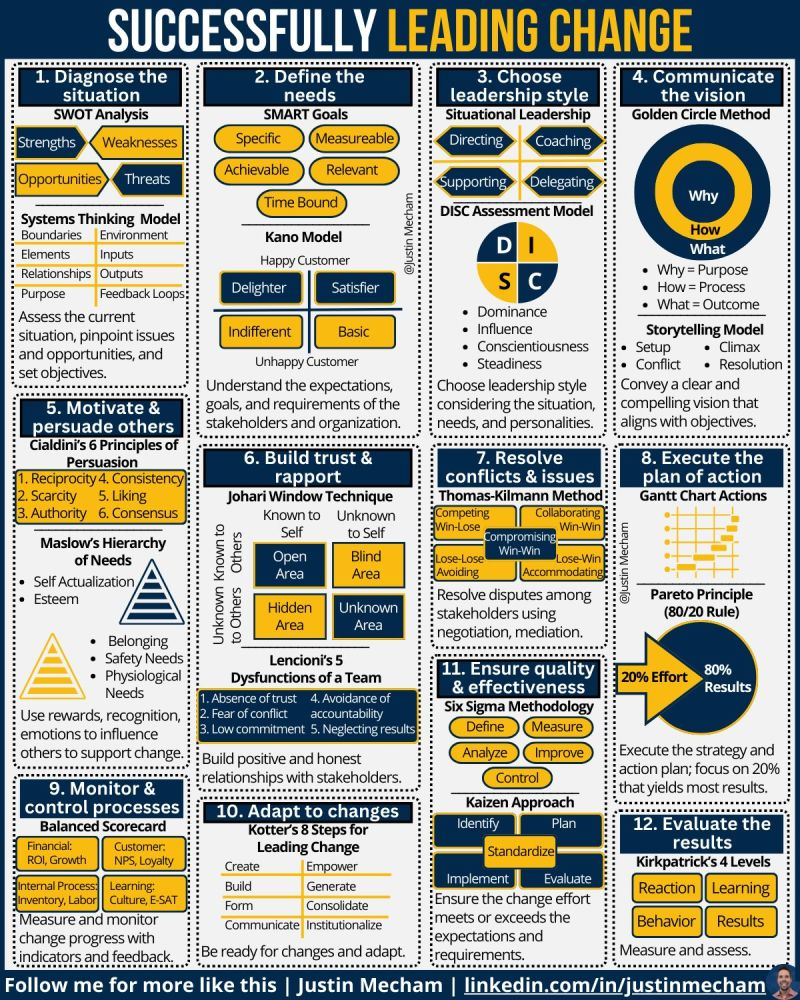
“How to successfully lead change”
Leading change is vital for leaders in any context. Change is necessary for survival and growth. However, 70% of business transformations fail (McKinsey and Company), while top change-leading firms yield a 32% return (Harvard Business Review).
Here’s a guide to leading change effectively thanks to Justin Mecham
Understanding the Need for Change
Change is inevitable in the business landscape. It is crucial to understand why change is necessary. The key reasons include staying competitive, adapting to market demands, and fostering innovation.
Assessing Readiness for Change
Before diving into change, assess your organization’s readiness. This involves evaluating the current organizational culture, resources, and the potential resistance you might face.
Setting Clear Goals and Objectives
Define what you aim to achieve with the change. Setting clear, measurable goals helps in creating a focused roadmap and provides a benchmark to measure progress. Ensure these goals are aligned with the overall vision and mission of your organization or personal venture.
Developing a Strategic Plan
A well-thought-out plan is the backbone of successful change. This plan should outline the steps needed to achieve the set goals, timelines, resources required, and key stakeholders involved. Flexibility is key; be prepared to adjust the plan as needed.
Communication: The Key to Buy-In
Effective communication is crucial in leading change. Clearly communicate the why, what, and how of the change to all stakeholders. This openness not only helps in getting buy-in but also reduces resistance and fosters a culture of trust.
Implementing the Change
The implementation phase involves putting the plan into action. It’s essential to manage this phase carefully, with close monitoring and support. Address challenges promptly and be open to feedback from all levels of the organization.
Monitoring Progress and Adapting
Regularly monitor the progress of the change initiative. Use the set goals and objectives as a metric to measure success. Be prepared to adapt the plan based on feedback and the evolving business environment.
Reinforcing Change and Making it Stick
Recognize and celebrate small wins to keep the momentum going.
Continuous Learning and Improvement
Change is a continuous process. Encourage a culture of continuous learning and improvement within your organization.
Leading change is not a one-size-fits-all approach. What works for one organization may not work for another. The key is to understand your unique context and adapt these strategies accordingly.
Méthode Switch
Source : https://www.youtube.com/watch?v=8c7PcR2uMyI Eliott Meunier
La méthode Switch repose sur la Manipulation pour induire un changement de comportement.
La méthode peut être rapportée à cette image : C’est un conducteur, qui est sur un éléphant, qui avance sur un chemin. Tout changement revient à adresser un ou plusieurs des 3 points suivants :
- Diriger le conducteur ( Ta conscience, celle des autres personnes)
- Il faut une vision Claire, que la destination soit établie (objectif, Plan de vie, …)
- La destination à prendre doit être super claire pour que l’aspect analyse de Ton système mental soit réduit à cette question : comment est-ce qu’on fait pour y aller ?
- Utiliser la technique des ‘Bright Spots’
- Se demander : Qu’est-ce qui marche aujourd’hui et qu’on pourrait encourager ?
- Ex: plutôt que de demander à un insomniaque pourquoi il dort pas, lui demander si il y a une fois dans le mois où il a bien dormi ? → L’art des questions (coaching)
- Ex : Demander, si demain le problème avait disparu, qu’est-ce qui aurait changé autour de toi ?
- Ex : Demander s’il y a eu un événement ‘miraculeux’ qui s’est déjà produit, mais pas assez fréquemment ?
- Enlever le Paradoxe du choix
- Réfléchir à toutes les options en amont et réduire les choix au minimum pour le conducteur
- visualiser la destination
- Objectif SMART est problématique car il manque l’aspect motivation
- Inspiration
- Se demander : Qu’est-ce qui marche aujourd’hui et qu’on pourrait encourager ?
- Il faut une vision Claire, que la destination soit établie (objectif, Plan de vie, …)
- Motiver l’éléphant (ton Subconscient, les foules…)
- On veut lui donner de la Motivation, en accord avec ses Émotions et Croyances
- Amorçage
- On veut évoquer les Émotions négatives si ça fait sens (situation catastrophique, survie)
- Le plus souvent, on veut évoquer les Émotions dites positives car ça aide les gens à partager
- On veut donner des retours rapides, des petits succès, qui donnent de l’Espoir et permettent de Reprogrammer ton esprit
- On veut lui donner de la Motivation, en accord avec ses Émotions et Croyances
- Montrer le chemin (Besoin d’appartenance, Désir mimétique)
- Faire temoigner les gens pour qui le changement fonctionne
- Modifier l’environnement pour réduire la Friction au démarrage
- Préparation
- Dissonances cognitives
- Pour eviter la dissonance, on fait agir les autres. Une fois qu’ils ont agit, ils pensent comme ils ont fait, ce qui les encourage à aller plus loin : Ton expérience reprogramme tes croyances
Liens: Comment dépasser la résistance au changement chez les Autres Comment lancer une initiative